

MLK Community Center – Energy Resiliency Hub
Keeping the power on when our community needs it most.
In 2026, the first community-based microgrid in Eastern Washington began powering the Dr. Martin Luther King Jr. Family Outreach Center (MLK Center) in East Central Spokane.
A microgrid is a local power system that helps keep essential services running when the main electric grid goes down.
This project helps ensure the MLK Center can keep serving our community—even during long or unexpected power outages.
It takes all of us. If one succeeds, all of us succeed.
And if we just invest in everyone, then we're a healthier, smarter, better community for it.
The MLK Center is a resource for people in the community.
We’re addressing food insecurity, families who are looking for affordable, high-quality childcare, or a variety of social and educational programs, primarily to low-income children, youth, and families in Spokane.
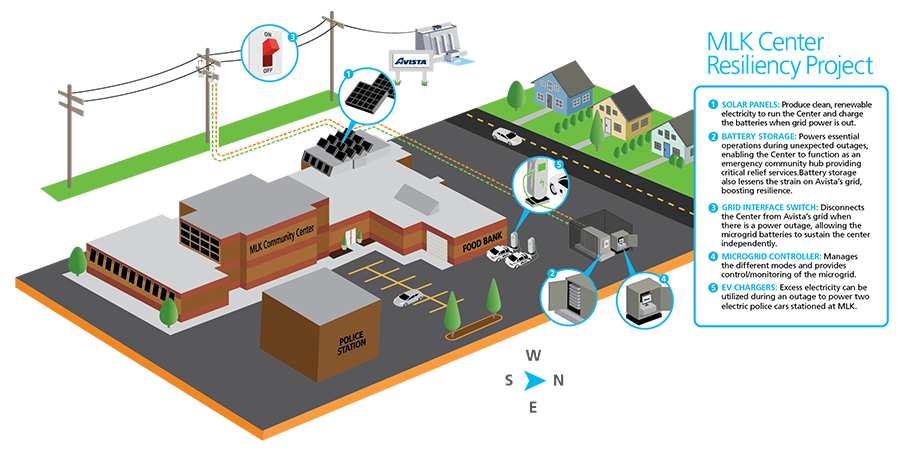
At the community center, we've built this microgrid to help provide resilience during power outages. We're seeing more extreme weather events in our communities. And so, the need for cooling centers or heating centers and have access to electricity in those kind of emergency events is just going to be more frequent going forward. If the power goes out on the main grid, we basically have a switch. Think of it as a big light switch. And when the power grid goes down, we open up that switch and we turn on the battery backup. That battery backup is connected through a controller. And the controller routes the power from the solar or the gas generator either into or out of that battery with the goal of making sure that the community center stays energized and they can meet the needs of serving their mission for the community here even when the main grid is down. If you for some reason during a storm or any type of natural disaster don't have power, MLK will thanks to Avista and this project. This project was made possible by two different grants. One from the Washington State Department of Commerce and the other grant from Avista's Named Communities Investment Fund. And we've partnered with the Martin Luther King Jr. Community Center as well as the city of Spokane to create the first of what is hopefully many community resilience hubs. We're always looking at how are the risks we're managing on behalf of our customers changing and can we take advantage of technology as it's advancing to better manage those risks for our customers. My hope for the future for the MLK Center is that we continue to access the need in the community, continue to partner with amazing people like Avista to have the biggest impact that we can have in our community.
Why the MLK Center?
The MLK Center is a trusted community resource in a diverse Spokane neighborhood. People rely on it for services like its food pantry, childcare, family support services, and more.
Creating a microgrid here helps:
- Support essential services during unplanned and extended outages
- Strengthens community resilience
How a microgrid helps.
The microgrid uses three energy sources working together:
Solar panels
Battery storage
Natural gas backup
On a normal day, the MLK Center uses power from the electric grid, with added support from the solar panels and batteries from this project.
If the grid goes down, the batteries and solar help keep electricity flowing. If an outage lasts longer, natural gas backup kicks in so the Center can stay open and operational.
Using less energy helps the microgrid do more.
As part of this project, Avista supported lighting upgrades throughout the MLK Center. These upgrades reduce energy use while keeping spaces bright, safe and welcoming.
When a building uses less energy, battery power can last longer during an outage. That helps extend how long the Center can continue serving the community.
Lower energy costs mean more support for programs.
By generating some of its own power, the MLK Center can lower its energy bill. That means more dollars can go back into programs that support families and strengthen the neighborhood.
Innovation can be guided by community needs.
This microgrid reflects a different way of thinking about innovation.
Instead of asking people to go somewhere unfamiliar during an emergency, this project was built at a place the community already knows and trusts.
As weather patterns change and outages become more common, people are experiencing energy differently. Projects like this help explore new ways to add value, strengthen reliability and build on the power grid we already have.
This project is an example of the Avista Energy Innovation Lab’s work benefiting the community. Avista Utilities established this department to help turn new energy ideas into real solutions that benefit customers.
Resilience is powered by partnership.
This project reflects a shared energy economy, where local energy resources and customer participation help build stronger communities and make more reliable power possible.
This microgrid came to life through grant support from:
- Washington State Department of Commerce
- Avista’s Named Communities Investment Fund (NCIF)

NCIF is the only program of its kind at a Washington utility.
NCIF was created in response to the Clean Energy Transformation Act (CETA). It supports energy projects in communities facing greater challenges—including those related to extreme weather and economic or social inequities.